Infection After Breast Augmentation: Inside an Emergency Implant Removal
Short answer: when a breast implant pocket becomes infected, antibiotics alone rarely resolve it. In most established periprosthetic infections the implant has to come out, the pocket has to be washed out and cultured, and the patient needs intravenous antibiotics under inpatient monitoring. In the case described below, a 31-year-old woman was operated on the same night she presented, with a white cell count of 16.3 K/μL and more than 90 ml of collected fluid and clot drained from the two pockets.
Last reviewed September 2026. Medically reviewed by MSc, MD Ho Cao Vu — Practising Certificate No. 028475/BYT-CCHN. More than 15 years in aesthetic plastic surgery and more than 20 years of general surgical experience at Cho Ray Hospital; trained in post-cancer breast reconstruction at MD Anderson Cancer Center, USA.
Why this case matters for anyone considering breast surgery abroad
Infection is not a rare theoretical footnote in breast augmentation. According to the FDA, infection is one of the recognised risks of breast implants, alongside capsular contracture, rupture and implant malposition. Published surgical series generally report infection after primary augmentation in the region of 1–2.5 % of cases, with higher rates after revision surgery.
What separates a manageable problem from a serious one is almost never the infection itself. It is the delay.
Dr Ho Cao Vu notes that the most damaging factor he sees in referred infection cases is the interval between the first warning sign and definitive treatment. Every additional day allows fluid, clot and pseudomembrane to accumulate inside a closed space that has no blood supply of its own — and no antibiotic can reliably sterilise the surface of a silicone device once bacteria have established a biofilm on it.
This article follows one real case from first symptom to discharge, and then sets out what the evidence says about each decision point. It is written for readers who are weighing up surgery, and for patients who are currently worried about symptoms after an operation performed elsewhere.
The case: Ms T, 31 years old
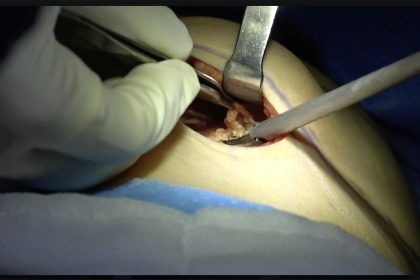
On 10 September, MSc Dr Ho Cao Vu operated on Ms T, a 31-year-old woman from Binh Tan District, Ho Chi Minh City, who had developed an infection during breast augmentation performed at another facility.
Before surgery
Ms T had never given birth. She was self-conscious about very small breasts and wanted a substantial size change. On a friend’s recommendation she attended a cosmetic clinic in Ho Chi Minh City.
Her breasts hung slightly downward, with grade 1 ptosis before surgery. The doctor at that clinic assessed her and recommended breast implants combined with an areola reduction to improve the sagging.
The first five days
About five days after the operation, Ms T began to notice:
- oedema and a feeling of tightness across both breasts
- breathlessness
- considerable pain, beyond what she had been told to expect
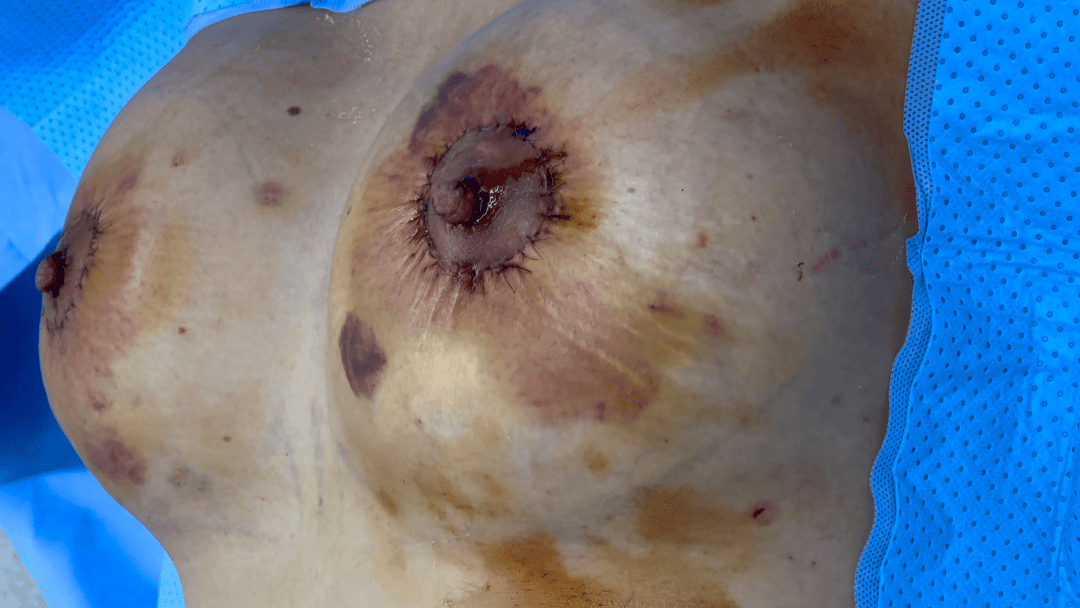
- several worrying areas of swelling and bruising
She contacted the clinic. The reply she was given is quoted here as she reported it to the surgeon:
“In the first one to three days after surgery this is normal; if you want the implants removed, you have to wait a month until things settle down before they can come out.” — the clinic that performed her augmentation, as reported by the patient
That advice is the pivot point of this case. Symptoms appearing on day five — not day one to three — and worsening rather than settling are not the expected post-operative course. Overwhelmed and unable to bear the pain, Ms T sought a second opinion at MSc Dr Ho Cao Vu’s plastic and reconstructive practice.
Examination findings
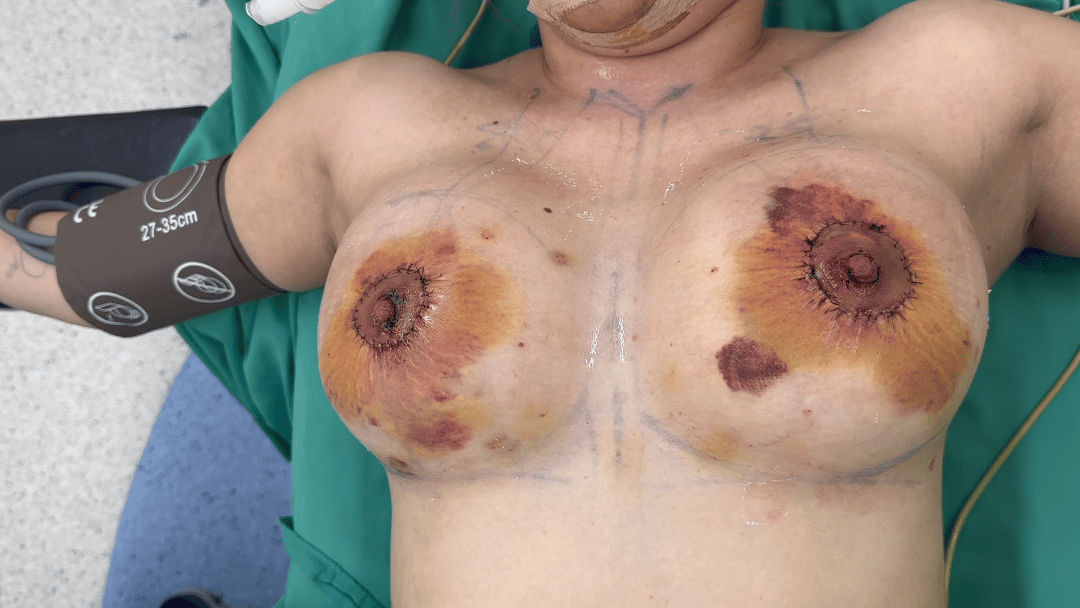
Dr Vu examined her personally and found her condition serious:
- foul-smelling breath
- breasts swollen, tense and enlarged
- breathlessness
- multiple areas of swelling and bruising over the breast and the inframammary fold
He ordered immediate laboratory tests and arranged removal of the implants at a fully equipped general hospital.
What the tests showed
Her white blood cell count (WBC) was 16.3 K/μL. The normal reference range is roughly 4–10 × 10³/μL, so her count was well above the upper limit — a systemic inflammatory response, not a local irritation.
Her remaining results met ASA standards as assessed by the anaesthetic team. Because she was fit for anaesthesia and the clinical picture was deteriorating, Dr Vu operated that same night.
The operation
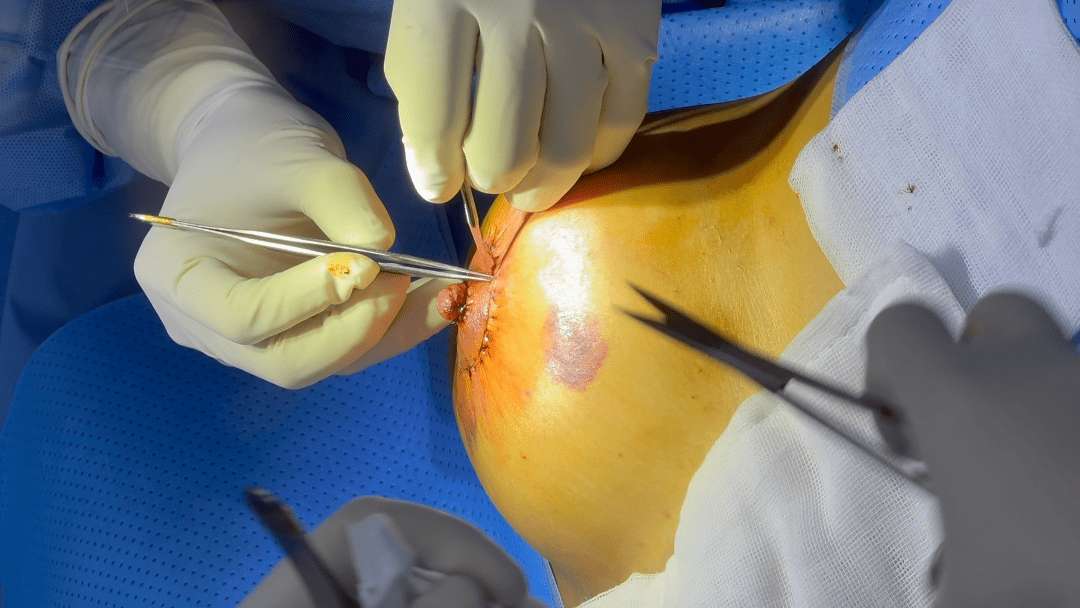
The surgical sequence was:
- Fluid taken for microbial culture and antibiotic sensitivity testing — before any antibiotic could distort the result.
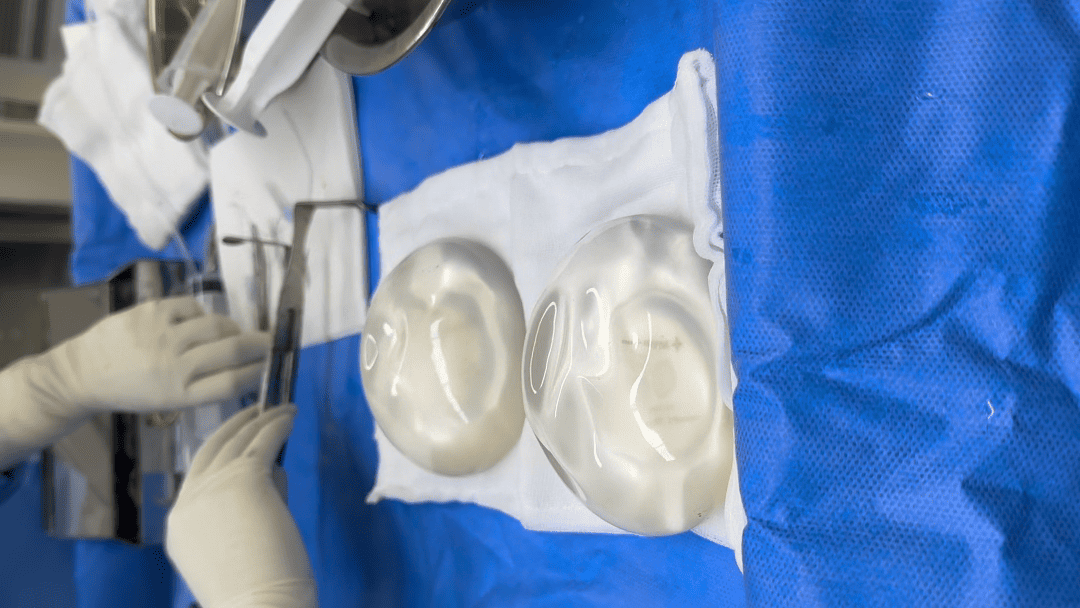
- Implants removed from both sides.
- Aspiration of all collected fluid and blood clots from each pocket: more than 50 ml of thin bloody fluid on the left and more than 40 ml on the right, with many dark blood clots.
- Irrigation and cleaning of the breast pocket with saline (NaCl) and Povidone.
Recovery
Because Ms T had signs of surgical-site infection that were seriously affecting her health, she was admitted for three days of intravenous antibiotics, with monitoring of vital signs and clinical condition.
She was discharged only once she had fully recovered, was eating well, was psychologically stable, and her white cell count had returned to normal.
Why the implant had to come out
Patients frequently ask whether a strong course of antibiotics could have saved the implants. In an established periprosthetic infection, the honest answer is usually no, and the reason is mechanical rather than pharmacological.
A breast implant is an avascular foreign surface. Antibiotics reach infected tissue through the bloodstream. A silicone shell has no blood supply, so a drug circulating at a therapeutic level in the patient’s tissue may never reach an effective concentration on the surface of the device itself.
Bacteria form biofilm. Research shows that organisms adhering to an implant surface produce a protective extracellular matrix. Bacteria within biofilm tolerate antibiotic concentrations far above those that kill the same organisms in free-floating form. This is why source control — removing the device — is the standard of care in prosthetic infection across surgical specialities, not only in breast surgery.
A closed pocket accumulates. Once fluid, blood clot and pseudomembrane collect inside a capsule, there is a reservoir that antibiotics cannot clear and that the immune system struggles to reach.
Evidence suggests that in early, mild cellulitis without a collection, targeted antibiotics may occasionally control infection with the implant in place. Where there is a documented collection, systemic signs and a raised white cell count — as in this case — explantation with thorough washout is the safer route.
Why culture was taken before antibiotics
Taking fluid for microbial culture and antibiotic sensitivity testing at the start of the operation is a small step with large consequences.
Guidelines recommend obtaining specimens before starting or escalating antimicrobial therapy in suspected prosthetic infection, because prior antibiotics substantially reduce culture yield. A negative culture in a patient who is clearly infected leaves the team treating blind, usually with broad-spectrum agents for longer than necessary.
In breast implant infection, the organisms most often reported are Staphylococcus aureus and coagulase-negative staphylococci, with Gram-negative organisms and, less commonly, mycobacteria also described. Sensitivity testing allows the intravenous regimen to be narrowed to what actually works for that patient.
This is also why, in revision cases, Dr Vu sends pseudomembrane not only for antibiotic sensitivity culture but for histopathology and tuberculosis testing — because a persistent, unusual inflammatory picture occasionally has an unusual cause.
Warning signs that should never wait a month
The advice given to Ms T — wait a month — is the specific failure this article exists to prevent. Based on this case and on standard post-operative guidance, the following warrant urgent reassessment rather than reassurance:
- New or worsening pain after day three. Post-operative pain should trend downward. Pain that increases is a signal.
- Fever, chills, a bitter taste, or feeling generally unwell. These suggest a systemic response.
- Swelling that increases rather than settles, particularly if one side changes markedly relative to the other.
- Redness spreading over the breast skin, or skin that is hot to touch.
- Any discharge from the incision, especially yellow, cloudy or foul-smelling fluid.
- Breathlessness or a foul smell on the breath, as in this case.
- A wound that stops healing or reopens.
Dr Ho Cao Vu notes that a patient is never wrong to ask for an urgent examination. The cost of an unnecessary check is one appointment. The cost of a missed infection can be the pocket itself — and with it, the possibility of a good result at any future operation.
What cleaning the pocket actually means
Explant surgery is often described to patients as simply taking the implant out. In an infected field it is the washout that determines whether the breast can be reconstructed later.
The pocket is irrigated to remove:
- collected fluid and blood clot, which act as a culture medium
- pseudomembrane — the clumped, mucoid material that forms in an inflamed capsule
- necrotic tissue, which will not heal and continues to feed inflammation
In this case, irrigation used saline and Povidone. Antiseptic irrigation of the implant pocket is widely practised, and Dr Vu’s protocol also uses hydrogen peroxide and Betadine followed by thorough saline lavage in more heavily contaminated revision cases, with a post-operative irrigation drain left in place where the field warrants it.
The consequences of an inadequate washout are documented in Dr Vu’s revision practice: a pocket that still contains pseudomembrane, necrotic tissue, clot or discharge cannot accept an implant. The surgeon must re-operate, clean the pocket thoroughly, culture, place a drain and irrigate continuously until the pocket stabilises — a far longer road than doing it properly the first time.
What this means for the patient’s future
Ms T’s implants were removed as an emergency. That is not the end of her options, but it does change the timeline.
After an infected explant:
- The pocket must be given time to settle and re-adhere. Re-implantation into an unstable or inflamed pocket risks repeating the problem.
- Where too much tissue has been excised, or where the pocket fails to re-adhere, later implant placement may be difficult or impossible.
- Each subsequent operation carries a higher infection risk than the first, which is why revision cases are treated with more caution, not less.
This is the strongest practical argument for choosing the operating surgeon and facility carefully at the first operation, rather than planning to fix problems later.
Choosing a surgeon and facility: what to verify
For readers travelling to Vietnam for breast surgery, or choosing locally, the following are verifiable before booking:
- Who performs the operation, by name, and their practising certificate number.
- Where the operation takes place. In this case the implants were removed at a fully equipped general hospital — relevant because emergency management requires laboratory support, anaesthetic cover and inpatient beds.
- What happens if something goes wrong at ten at night. Ask directly: who examines me, where, and how quickly.
- Whether cultures are taken routinely in any suspected infection, before antibiotics.
- The plan for follow-up, including who to contact and the threshold for being seen urgently.
The NHS guidance on cosmetic breast implants and the American Society of Plastic Surgeons make the same point in different words: confirm who is operating, where, and what the arrangements are if a complication develops.
At Dr Breast X, consultation and assessment are provided by the clinic; surgery is performed by MSc Dr Ho Cao Vu at Nam Sai Gon International Hospital.
Frequently asked questions
Can an infected breast implant be saved with antibiotics alone?
Rarely. Antibiotics reach tissue through the bloodstream, but an implant has no blood supply and bacteria on its surface form biofilm that tolerates high drug concentrations. Where there is an established collection and a systemic response — fever, raised white cell count — removal with washout is the standard approach. Early, mild cellulitis without a collection is the exception that may respond to targeted antibiotics.
How soon after breast augmentation does infection usually appear?
Most periprosthetic infections present within the first six weeks after surgery, and many within the first two. In this case symptoms began on day five. Late infections can occur, sometimes years afterwards, which is why any new breast swelling, pain or discharge in a patient with implants deserves assessment.
Is a white blood cell count of 16.3 dangerous?
A WBC of 16.3 K/μL is well above the usual reference range of roughly 4–10 × 10³/μL and indicates a significant systemic inflammatory response. It is not a diagnosis on its own — it is interpreted alongside symptoms, examination and imaging — but combined with breast swelling, pain and foul-smelling breath it supported the decision to operate the same night.
Will I be able to have implants again after an infected explant?
Often yes, but not immediately. The pocket must settle and re-adhere first. Where infection has destroyed tissue, or where the pocket fails to re-adhere, later implant placement can be difficult. The outcome depends heavily on how thoroughly the pocket was cleaned at the explant operation.
How long is the hospital stay for an infected explant?
In this case, three days of inpatient intravenous antibiotics with monitoring of vital signs, discharged only once the white cell count normalised and the patient was eating well and psychologically stable. Stay length is determined by the clinical response, not by a fixed schedule.
What should I do if my clinic tells me to wait a month?
Seek a second opinion promptly, ideally at a facility with laboratory and inpatient capability. Symptoms that begin after day three and worsen are not the expected recovery course. Waiting allows fluid, clot and pseudomembrane to accumulate in a space antibiotics cannot reach.
Key points
- According to the FDA, infection is a recognised risk of breast implants; published series report roughly 1–2.5 % after primary augmentation and higher after revision.
- Established periprosthetic infection usually requires implant removal, not antibiotics alone, because of biofilm on an avascular surface.
- Culture should be taken before antibiotics are started or escalated.
- Symptoms that begin after day three and worsen are not normal recovery.
- The quality of the pocket washout at explant determines whether reconstruction is possible later.
References
- US Food and Drug Administration — Risks and Complications of Breast Implants. FDA — Risks and Complications of Breast Implants
- US Food and Drug Administration — Breast Implants: Information for Patients and Providers. FDA — Breast Implants: Information for Patients and Providers
- American Society of Plastic Surgeons — Breast Implant Removal. American Society of Plastic Surgeons — Breast Implant Removal
- NHS — Breast implants (cosmetic procedures). NHS — Breast implants (cosmetic procedures)
- National Library of Medicine (PMC) — literature on periprosthetic breast infection and biofilm. PubMed Central — periprosthetic breast infection and biofilm
This article describes one patient’s course and is provided for general information. It does not replace an in-person medical assessment. If you have symptoms after breast surgery, seek examination promptly.